
Published May 20, 2026 · Updated May 22, 2026
Estimates for the size of the global video game market vary, but most estimates list the industry’s value at over $300 billion, with Precedence Research projecting it to exceed $720 billion by 2034. Despite its big-business credentials, one reason it holds so much sway in culture today is the democratizing power of some of the underlying technology. Notably, the implementation of community servers shows that developers and publishers are happy to give players a stake in the experiences they offer.
Servers operated by the player base have been around for as long as online connectivity itself, although this has come a long way from its amateur origins, and the industry has reached a point where these digital hubs are an economic force in their own right.
The Importance of Third-Party Server Solutions
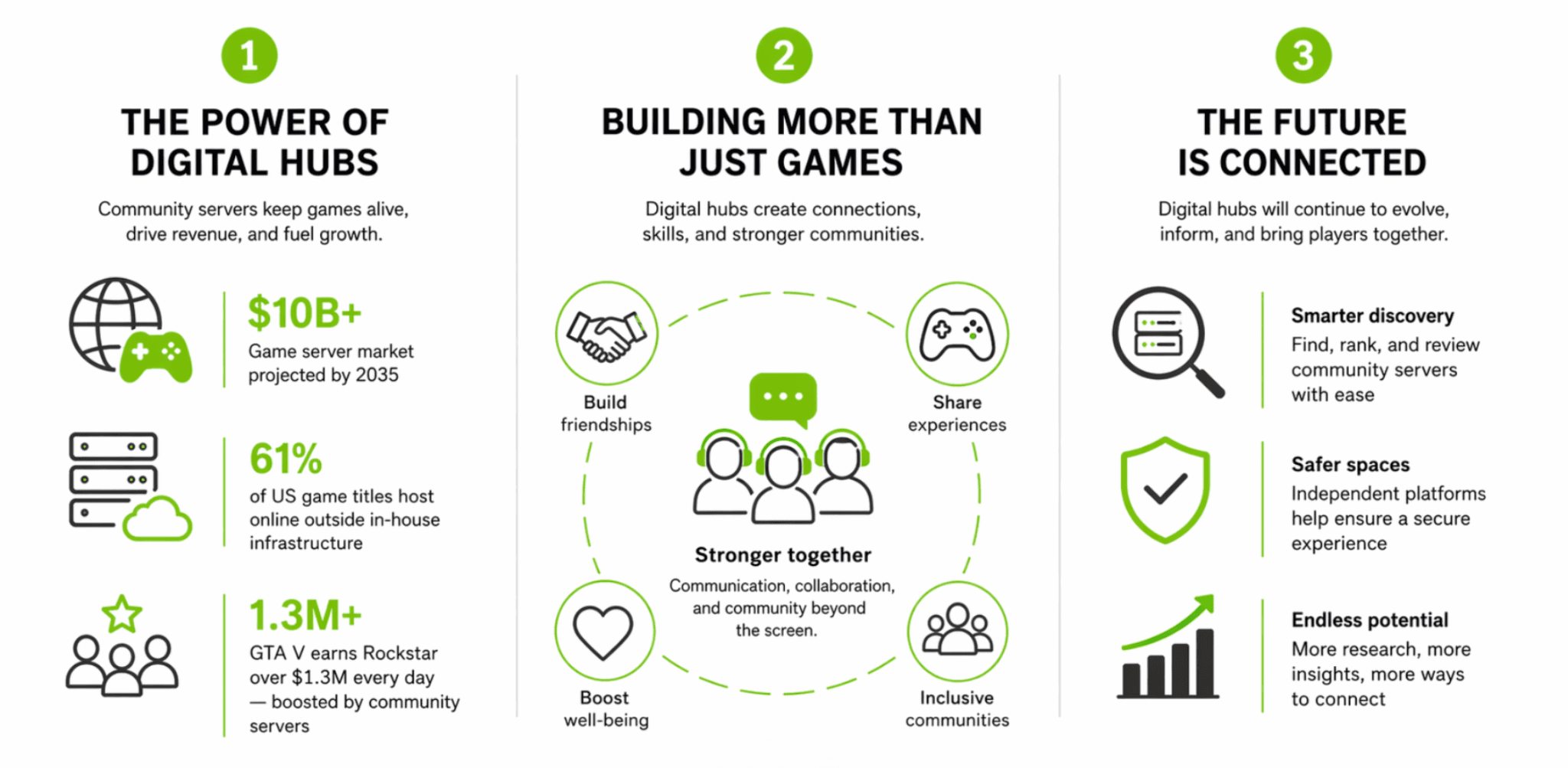
The market for game servers is valued at $5.85 billion, according to Business Research Insights, and will top $10 billion by 2035, with projected year-on-year growth of 6.95%. While major games of all kinds arrive with first-party server support as standard, this market analysis clearly shows that third-party servers are even more significant. In fact, 61% of titles developed in the U.S. host the online portion of the experience outside in-house infrastructure.
Community servers represent a much smaller slice of this market, but their impact is arguably greater when taken as a whole. Data from the community server analytics platform MineRank suggests that many players migrate toward community-run hubs once they have exhausted a game’s standard content. These independent servers offer a blend of unique game modes and social circles that operate outside the direct oversight of major corporate publishers.
“Minecraft” is a major example of a game that continues to flourish and grow thanks to community servers, but it’s not the only online IP that has perpetuated its long-term commercial viability through this route. For instance, RockStar’s “Grand Theft Auto V,” originally released in 2013, continues to make its publisher $1.3 million every day, and third-party server support feeds back into first-party profits. So, players have a reason to stick around, and companies keep wringing revenue out of long-established games.
The Social Benefits
The financial side of the community server ecosystem is interesting to outsiders, but there are other benefits to encouraging the proliferation of these digital hubs where people can play together, and the social aspect is perhaps the most important of them all. Despite calls for a ban on social media for under-16s in many countries, and arguments from some corners that our modern obsession with digital experiences is detrimental to our broader social skills and mental health, online gaming could be the exception to this.
A recent meta-analysis of studies on online gaming argued that it has the potential to bring about positive change at both the individual and societal levels. Players encouraged to communicate and collaborate in these digital hubs develop skills and build empathy with others, and are exposed to a range of interactions beyond direct gameplay, such as watching live streams on Twitch and YouTube.
Rather than being a socially isolating activity, community servers in particular and online gaming more broadly impart a sense of belonging in those who might traditionally have struggled to fit in with face-to-face social scenarios. The World Health Organization is in the process of exploring the benefits of digital play from a public health perspective, once again drawing attention to just how advantageous this widespread and often misunderstood pastime can be. This move suggests these digital spaces are finally being seen as vital tools for building community in a disconnected world.
What Next for Digital Hubs?
Online gamers have the opportunity to engage and interact with other players in ways that were previously impossible, and accessibility is better than ever, since finding community servers can be readily reviewed, ranked, and checked for safety, thanks to the range of independent platforms designed to do just that.
It’s apparent that more research is needed to better understand the full picture of how these digital hubs really pay dividends for player social skills and mental health. However, it’s refreshing to see that this is an active line of research, given that so much attention in the media points to the negative effects of the likes of gaming addiction.

Udayveer Singh
Udayveer Singh is a contributor to our news feed here at Minerank and is passionate about all things Minecraft!